

About the website
  Newsletter Archives
  Client Log-in
  Passport information
  (from U.S. State Dept)

  Trip Evaluation (Hiking)

  John Osaki's Blog
  Amy Osaki's Blog


View of the Sete Cidades caldera, Sao Miguel, Azores

THIS TRIP IS NOT CURRENTLY SCHEDULED.
Over the years, Mountain Hiking Holidays has developed and operated trips to a variety of destinations including this one, but not all trips are offered every year.
Though this trip is not currently being offered as a scheduled departure, we can  organize and operate this trip as a private group departure. (Minimum group size 8.)

Start organizing your private Madeira & Azores adventure here.


Best time to travel: April - September
Best gateway city: Funchal, Madeira & Ponta Delgada, Sao Miguel, Azores


Anchored in the cobalt Atlantic Ocean, the temperate islands of Madeira and the Azores (Açores, in Portuguese) boast some of Portugal's most dramatic mountains. Hike through the varied landscapes of Madeira where an extensive network of paths along the levadas (small irrigation channels) makes the rugged, mountainous topography of the island accessible to hikers providing thrilling and not-soon-to-be-forgotten trail experiences! Revel amidst the windswept highlands, plunging cliffs, terraced mountainsides, and peaceful, mossy laurisilva forests (which were named a World Heritage Site in 1999) of this enchanting island. In the Azores, volcanic highlands beckon. Here, colorful lakes nestle in volcanic calderas, towering sea cliffs plummet into the chilly waters of the Atlantic and hydrangea hedgerows and laurel forests add color and mystery to the landscape. Weather permitting, there's also an opportunity to ascend the volcano of Pico, the highest mountain in Portugal! 


The Levada da Negra descending from the highlands along the Ice Runner's Path


  View from the North Coast Path
Day 1
Introduce yourself to Madeira's "signature" hiking experience—the levada paths. The North Coast Path combines a walk along a levada with a spectacular hike along Madeira's rugged north coast. Follow the course of the Levada do Caniçal (the "mimosa levada") as it makes its way "through the backyards" of settlements at the upper edge of Machico town. The path then ascends gently to the Boca do Risco where a stunning panorama of the north coast cliffs awaits. From Boca do Risco the trail, etched into the cliff face and following more or less the 1,000 foot contour, makes its way west to the town of Porto da Cruz.

Descending the Ice Runner's Path

Alternatively, you can choose the "Ice Runner's Path," a route used by Madeira's "ice runners" who once carried this precious commodity (wrapped in straw and leather) from the poços da neve ("snow pits") in the Madeiran highlands to the population centers in the lowlands. This hike follows the course of the Levada da Negra as it makes its steep descent to the upper reaches of Funchal.

   
The Ice Runner's Path   


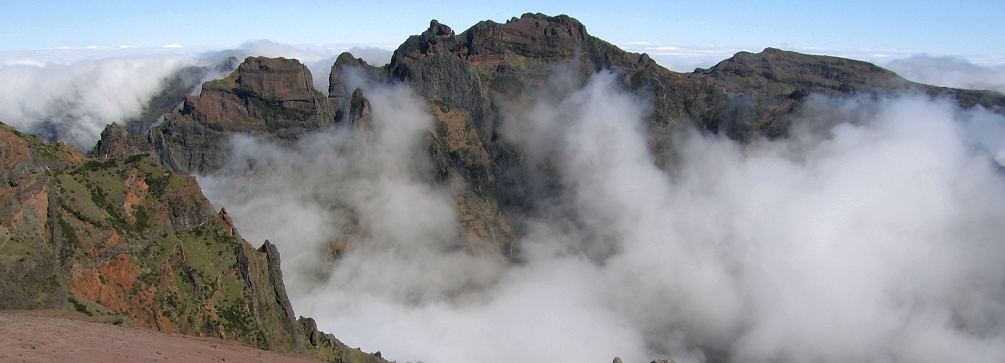
The cloud-wreathed peaks of the central Madeiran highlands seen from Pico Areeiro


On the trail to Boca da Encumeada
Day 2
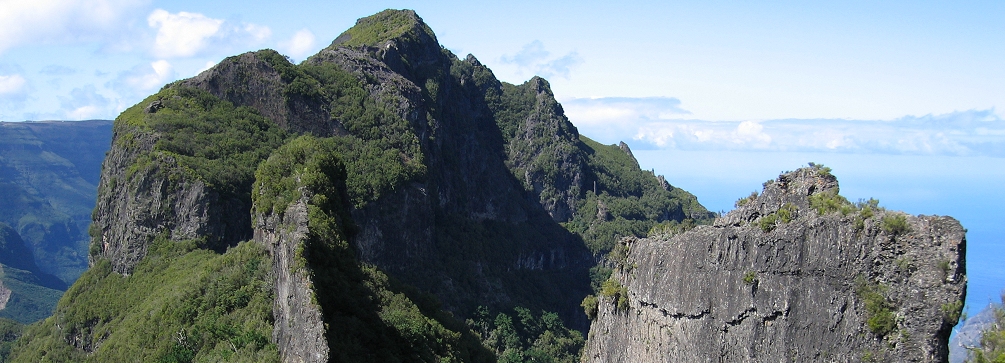
Explore the Madeira high country along trails that traverse the island's mountainous central spine. Hike the highland path from the summit of Pico Arieiro to Achada do Teixeira making a short detour to the summit of Pico Ruivo, Madeira's highest summit, en route. If you prefer a longer encounter with the "roof of Madeira" continue westward from Pico Ruivo along the crest of the island on a narrow path to the mountain pass at Boca da Encumeada. Along the way, you'll enjoy stupendous views looking down the headwalls of steep valleys that slice into Madeira's mountain core.


  Madeira's central spine seen from the path to Boca da Encumeada


The moss and fern-draped trail in the Fajã do Nogueira


Waterfall-splashed trail, Fajã do Nogueira

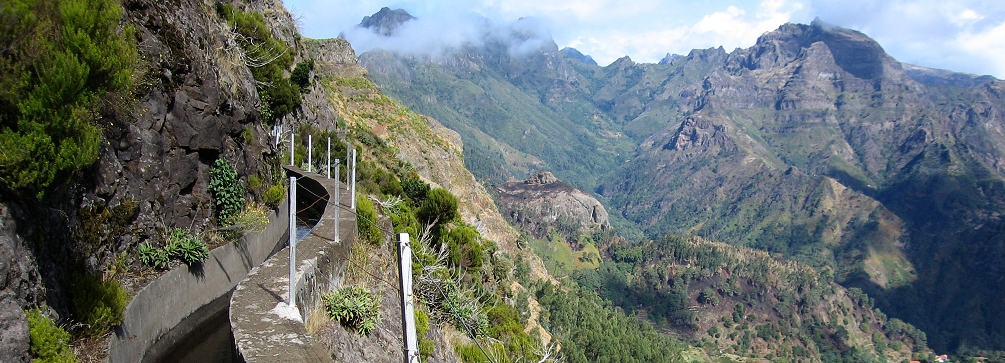
The Levada da Serra
Day 3
Enjoy hikes that will take you into narrow valleys walled-in by towering, fluted cliffs clad in subtropical greenery! A hike along the Levada da Serra, etched into the steep walls of the valley of Fajã do Nogueira allows you to experience this wonderful, nearly vertical landscape at close hand. For a longer hike, continue through the lengthy Ruivo tunnel and emerge into the fantastic and remote landscapes of the Caldeirão do Inferno. Here, waterfalls plunge over enormous cliffs and rushing waters roar through narrow gorges. Follow a levada to the Caldeirão Verde ("Green Cauldron") where a thousand foot tall waterfall plunges into a pool. Continue along the levada through waterfall-filled ravines with walls festooned with mosses and ferns to trail's end at the mountain park of Queimadas.


Neck-craning view of a waterfall in the Caldeirão do Inferno


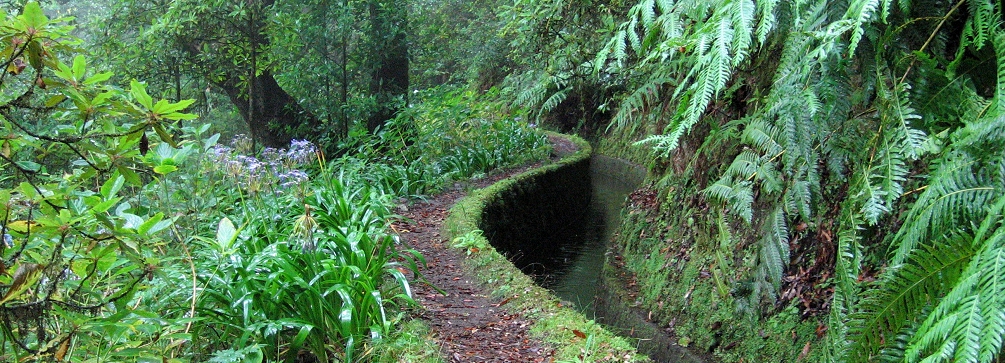
The Agapanthus-lined Levada do Norte with Pico Grande in the background


The luxuriant greenery of Folhadal

Curral Jangão
Day 4
Hike through the enchanting laurisilva forests of Folhadal along the Levada do Norte. These misty, mossy forests, luminous in their greenery, are comprised of a number of indigenous species including vinhaticos, til (laurel) and folhados ("lily of the valley trees"). These forests were named a World Heritage Site in 1999 and are a Madeira highlight! Beyond Folhadal, the Levada das Rabaças leads into the waterfall-draped Cascalho basin.

Alternatively, you can choose a more challenging hike—one that has been called the most beautiful mountain hike on Madeira. From the Boca da Encumeada the trail passes through the abandoned hamlet of Curral Jangão before ascending steadily to round the bulky shoulder of Pico Grande. The trail then picks its way along open ridges offering splendid views of Madeira's high peaks to the east and the windswept plateau of the Paúl da Serra to the west. You'll enjoy lovely views of the village of Curral das Freiras tucked into the deep valley of the Ribeira do Curral before reaching the terminus of the path at the mountain pass of Boca da Corrida.


A view of Pico Grande on the trail to the Boca da Corrida


The rugged and arid Ponta São Lourenço


The endemic Matthiola adds a splash of
color to the Ponta São Lourenço

Over Madeira en route to the Azores
Day 5
Enjoy a morning hike through the arid but spectacular landscapes on the Ponta São Lourenço where colorful cliffs and rock outcroppings contrast with the deep blue of Atlantic waters. Depart Funchal at mid-day for the flight to Ponta Delgada on São Miguel Island in the Azores. Travel to the picturesque town of Furnas set in the middle of one of São Miguel's three large volcanic calderas. Today much of the Furnas caldera is blanketed in lush pastureland criss-crossed by hydrangea hedgerows—a landscape typical of the Azores. But here and there, thermal springs and fumaroles issue from the earth, reminders of the volcanic upheavals that lifted the Azores from the depths of the Atlantic. For dinner, enjoy the local specialty known as cozido, a stew cooked in the heated earth of Furnas's themal basins.


Houses and steam clouds in Furnas


Lagoa do Fogo


Cryptomeria woods, Sete Cidades

Azorean levada, Lagoa do Fogo hike

View of Mosteiros town
Day 6
Today, explore the caldera lakes of São Miguel. Ascend to the Lagoa do Fogo ("Fire Lake"), a "crater lake" that fills a caldera to the west of Furnas. From São Miguel's south coast, a path ascends steadily through field, pasture, and woodland and eventually enters high altitude scrublands where tree heathers (Erica azorica) dominate. Mists often swirl around the Lagoa do Fogo and the cries of seagulls, unexpected in this high mountain landscape, add to the "lost world" atmosphere of the place. Or, explore the classic Azorean landscapes within and surrounding the magnificent Sete Cidades caldera filled with the waters of four lakes—the large Lagoa Azul and Lagoa Verde and the smaller Lagoa Rasa and Lagoa de Santiago. A trail along the caldera's eastern and northern rims offers a vista-filled "skywalk." Descend the northern slopes of the old volcano to the picturesque coastal town of Mosteiros.


Lagoa Azul in the Sete Cidades caldera seen from the crater rim trail


Entrance to the lava tube, Furna Frei Mattias. Photo by F. Passavant


An old stone hut on the way to Madalena
Day 7
This morning, fly from São Miguel to Pico island. Travel by vehicle to the lava caves of Furnas Frei Mattias high on the slopes of Pico. After exploring the caves follow a route through beautiful pasturelands and lovely rural landscapes back to Madalena, one of the principal towns on the island, where you'll spend the next two nights.


A view of Pico Volcano en route from Furna Frei Mattias to Madalena


Hiking up the lower slopes of Pico volcano


Lava flow at summit of Pico volcano  

View from Pico summit toward Faial Island
Day 8
Today you'll have an opportunity to climb to the summit of the highest mountain in the Azores and all of Portugal. The path to the summit of Pico volcano is steep but straightforward and "non-technical" in nature. Most people take about three hours to make the climb to the summit at a comfortable pace. The view from atop the volcano's 7,714 foot summit is astounding and ample reward for the effort. The open expanse of the Atlantic stretches to the horizon for three-hundred sixty degrees around you. On a clear day four neighboring Azorean islands are visible!
There is also the option of ferrying across to the neighboring island of Faial for less strenuous hikes along the rim of the island's principal volcano.


At the crater rim, Pico volcano

Looking into the Faial volcano


The Fajã João Dios seen from atop the sea cliffs


The town square, Velas
Day 9
This morning, ferry from Madalena to the island of
São Jorge (St. George). Enjoy a hike to the almost abandoned seaside hamlet of Fajã João Dios on São Jorge's north coast. The hamlet occupies a "tongue" of land, or fajã, jutting out into the sea at the base of the sea cliffs (some as high at 2,300 feet) that line much of the island's northern coastline. (The fajãs were formed by material accumulated from the erosion of the cliff face over time.) A well-graded, switchbacking trail descends from the cliff-tops to the isolated settlement. Or, choose a hike in the São Jorge highlands in the area of the Pico do Caldeirinhas and the Portal do Cedro. Volcanic cones pimple the landscape and hydrangea hedgerows create the stereotypical Azorean patchwork quilt of field and meadow.


The cone of Pico volcano rises above the São Jorge highlands; seen from near the Portal do Cedro


Descending the Caldeira de Cima

The old cobbled trail to Fajã da Caldeira de Santo Cristo

Day 10
Today's hikes along the south and north coasts of São Jorge rank among the finest in the Azores. These hikes follow what remains of the old cobbled paths that once linked isolated coastal settlements along São Jorge's rugged shoreline. These old cobbled routes have unfortunately been paved over in many places, so it's a treat to explore the sections that remain for a taste of Azorean life before the automobile. From the trailhead in the Serra do Topo highlands, the path makes a spectacular descent into the dramatic, steep-walled valley of the Caldeira de Cima. The path reaches sea level at the Fajã da Caldeira de Santo Cristo and continues along the coast at the base of waterfall-draped cliffs passing two other fajãs before arriving at trail's end at the Fajã dos Cubres.  If you desire, you can continue your trail adventure on the south coast hike between Lourais and São Tome—a good "companion" hike to the north coast walk. Hike the rugged coastline past secluded hamlets with ever present views to the south of the Pico volcano looming above the Atlantic. A farewell dinner this evening caps off your Madeira and Azores adventure!


Fajã São João seen from the South Coast walk, São Jorge

Other Resources
Read Isles Apart, a magazine article in the April 2005 issue of Travel and Leisure Magazine for one traveler's recent impressions of São Miguel island.
The Parque Natural da Madeira maintains a website (Portuguese only) containing information about nature reserves and nature protection activities on Madeira.
More information about Madeira's world heritage laurisilva forests can be found at the website of the United Nations Environment Program World Conservation Monitoring Centre. The World Wildlife Fund provides an interesting discussion of the Madeiran laurisilva in a report entitled, "Madeira's Evergreen Forests."
Check out Flora dos Açores for a great introduction to Azorean flora! Lots of photos. In Portuguese.


A Madeiran sunset enjoyed from Ponta do Sol. Photo by N. Passavant


L to R: Madeiran grapes; Hydrangea on São Miguel; the endemic Vaccinium cylindraceum on São Jorge

Back to top


Mountain Hiking Holidays Home

