

Hiking the Pyrenees
Trails in France and Spain

French & Spanish Pyrenees Slide Show
Wilder than the Alps, the grand, sculpted mountains of the Pyrenees form the natural border between France and Spain. Splendid trails lead to the magnificent cirques, lake-spangled basins, and knife-edged summits of France’s Pyrenees National Park. On the Spanish side follow trails that lead through the spectacular canyons of the Ordesa-Monte Perdido National Park, one of Europe’s oldest. In 1997, the United Nations inscribed a portion of the French and Spanish Pyrenees near the French village of Gavarnie and the Spanish village of Torla on its list of World Heritage Sites. Here, nature over the eons has carved three stupendous glacial cirques including the renowned Cirque de Gavarnie and a 3,000 foot deep canyon called Ordesa—Spain’s “Grand Canyon.” Explore trails that take you into the heart of these “world class” natural wonders. You’ll also explore the lush Marcadau Valley whose trails lead to high basins full of some of the most beautiful alpine lakes in the Pyrenees. Revel in a region where languages, food, and culture mix and flow. The Pyrenees are a feast for all your senses!
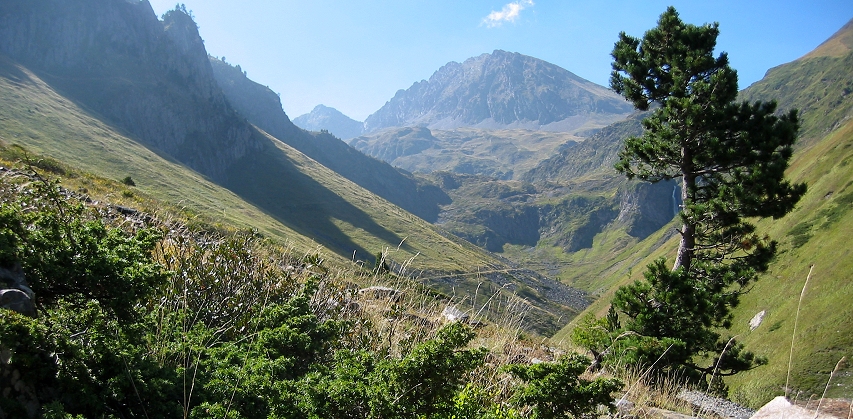
Ilheou Valley
Day 1
Overnight in Cauterets
Lunch and dinner included
Meet in Pau and travel to the mountain town of Cauterets on the threshold of the Pyrenees National Park. Cauterets is your base for three nights. After lunch in a local brasserie, travel by vehicle, and ascend the winding road into the Cambasque Valley, one of several valleys that converge on Cauterets. Enjoy an afternoon warm-up hike by following a portion of the long distance hiking route known as the GR10 (Grande Randonnée 10) up the open Ilheou Valley. The trail passes by a waterfall and tiny Lac Noir before arriving on the shores of picturesque Lac d’Ilhéou, a perfect introduction to the Pyrenees high country!
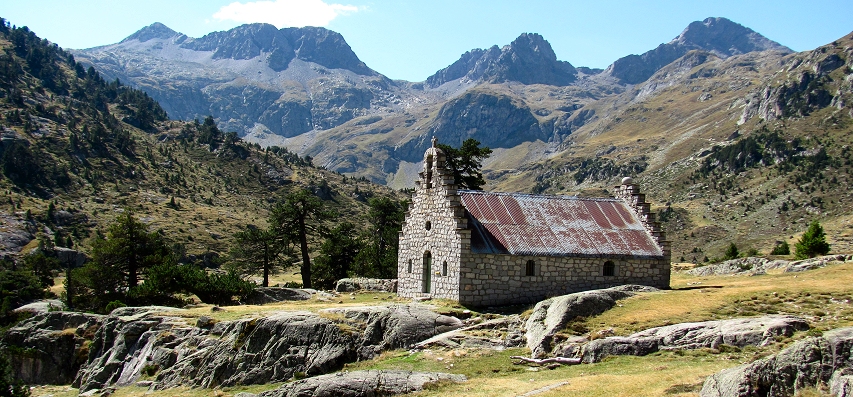
Chapel in the upper Marcadau Valley
Day 2
Overnight in Cauterets
Breakfast, lunch and dinner included
Transfer to the Pont d’Espagne in the Pyrenees National Park. Hike past meadows, waterfalls, and rushing streams in the lush landscape of the exquisite Marcadau Valley. The nearly level terrain of the Cayan Plateau offers easy walking through meadows laced with winding streams and punctuated by tall pines. Marcadau is a corruption of the Spanish mercado, which means “market.” The name reflects the importance of the valley as an ancient trading route across the Pyrenees. The Marcadau Valley was a crossing route for those on the medieval pilgrimage to Santiago de Compostella in Spain. Continue on to the Refuge Wallon at the junction of five mountain valleys close by the border with Spain. Gnarled pines grace the well-watered meadows around the refuge. A lovely stone chapel and a backdrop of high peaks completes the scene! Energetic hikers can undertake a strenuous 10-hour loop hike (known as the Circuit des Lacs) past a string of exquisite, rock-rimmed lakes. If you’re lucky you may see wild chamois (called isards in the Pyrenees) or even the elusive lammergeier in flight.
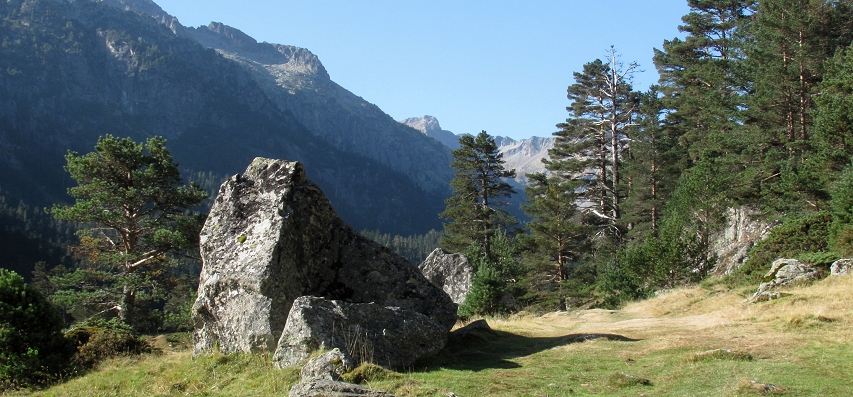
In the Marcadau Valley
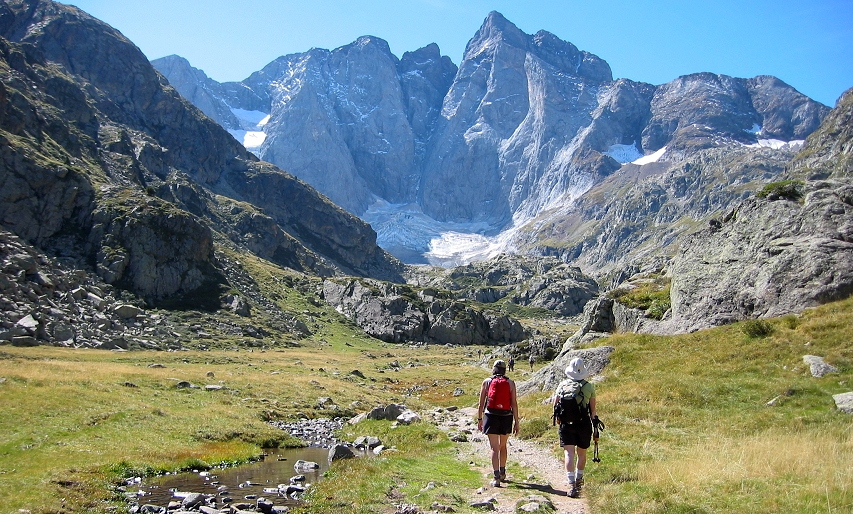
Hikers in the Gaube Valley
Day 3
Overnight in Cauterets
Breakfast, lunch and dinner included
Return to the Pont d’Espagne for a chance to explore the Vallée de Gaube which leads to the base of Vignemale—highest peak in the French Pyrenees. If the weather cooperates, you can gaze upon the peak that lured the 19th century Pyrenean mountaineer, Henry Russell, to climb it 33 times! Hike to the still waters of Lac de Gaube, the renowned “mirror of Vignemale,” hemmed in by mountain slopes. Ascend the increasingly open valley beyond Lac de Gaube to the foaming Cascade Esplumouse. Just beyond, a stunning view of the north face of Vignemale opens up—a Pyrenean classic! If you desire, continue up the Gaube Valley to the Refuge des Oulettes from where you can enjoy an astounding, close-up view of the vertical north wall of Vignemale. Return to the trailhead and spend a third evening in Cauterets.
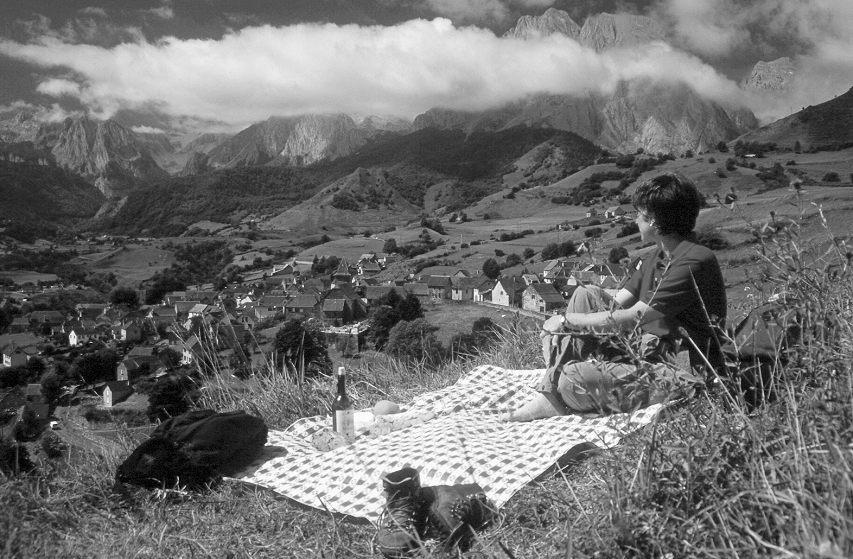
Here we are in our younger days reveling in the glory of the Pyrenees. Love at first sight!
Falling in Love with the Pyrenees
Our love affair with the Pyrenees began over a quarter century ago. We were young and enamored with the mountains (and we still are)! Over the years, we’ve journeyed across this three hundred mile long chain of peaks that serves as the gateway to the Iberian Peninsula. From the Atlantic to the Mediterranean, we explored the nooks and crannies of the range ascending twisting mountain roads to isolated high country villages. We once gave a ride to an old woman heading back to her village after a day with her goats in the high pastures. She filled our car with the aroma of goat’s milk, but that just added to our sense-surround experience of these wonderful mountains. We lounged in luxuriant meadows and toasted the peaks with a bottle of wine from lesser known appellations like Jurançon and Somontano. We lunched on fromage de brebis bought from a local farmer and enhanced with a slice of gâteau à la broche–a cake “baked” on a spit over a fire. Bliss! And, of course, the trails called. There are more than enough of them in the Pyrenees to last a lifetime of wandering. Here we discovered paths that led us through beech forests, along tumbling streams, and through rocky lake basins studded with sapphire-hued tarns. High on vertical canyon walls we picked our way along ledges (fajas) lined with edelweiss (flor de nieve) that led us into grand, wild mountain cirques where we saw no other human. Though the Pyrenees may not be as well known, or as well loved, as the Alps there is no doubt that these are mountains of the first order. They offer all the enchantments and joys that those of us who love the mountains seek. Come and fall in love with the Pyrenees!
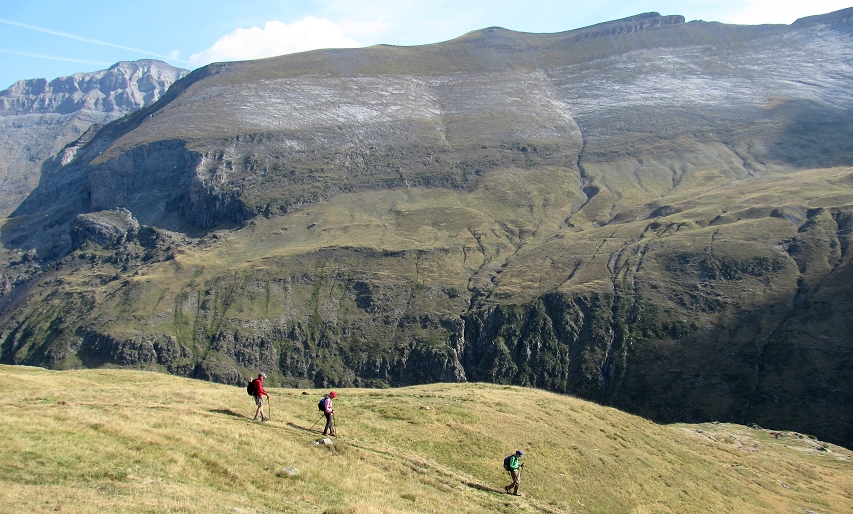
Hikers in the vast Cirque de Troumouse
Day 4
Overnight in Gavarnie
Breakfast, lunch and dinner included
Travel to Gavarnie by vehicle stopping en route to hike in the Cirque de Troumouse where alpine pastures are nearly encircled by impressive mountain ramparts. Trails wind their way through meadows and fields of wildflowers and alongside shallow tarns and rushing streams. The Cirque de Troumouse is one of the three cirques in the French Pyrenees that were inscribed on UNESCO’s World Heritage list in 1997. Our hotel in Gavarnie is situated “front and center” before the sheer walls of the stunning Cirque de Gavarnie. Settle in for a three-night stay.
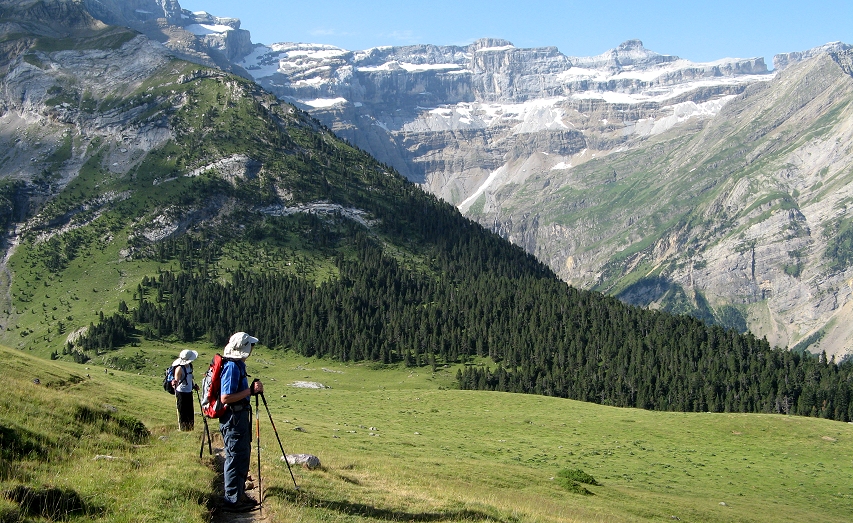
Cirque de Gavarnie
Day 5
Overnight in Gavarnie
Breakfast and lunch included
Gavarnie trails beckon! Hike into the awe-inspiring Cirque de Gavarnie by following a switchbacking trail that ascends to the meadows of the Plateau de Pailla. Continue on the trail as it descends gradually into the Cirque de Gavarnie. Portions of this trail follow natural limestone ledges and are similar to the faja trails in Spain’s Ordesa-Monte Perdido National Park. For a more strenuous outing, you can hike to the lofty Hourquette d’Alans for views into wide and lonely Cirque d’Estaubé before making the descent into the Cirque de Gavarnie.
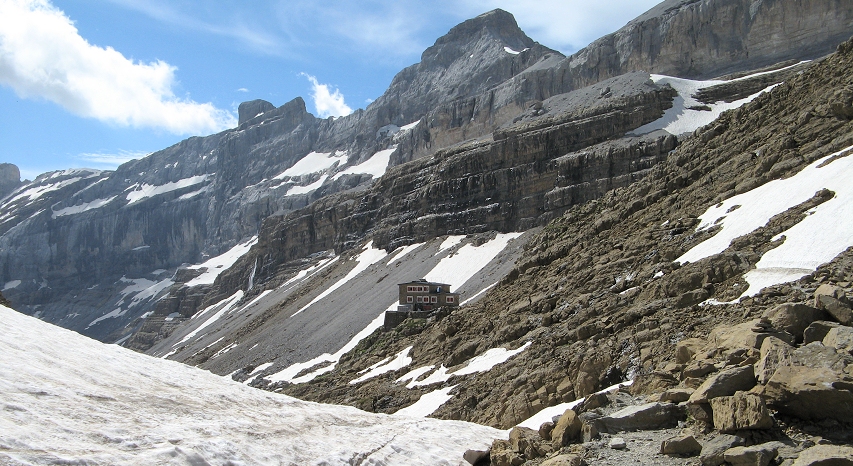
Refuge Sarradets below the Breche de Roland
Day 6
Overnight in Gavarnie
Breakfast, lunch and dinner included
Transfer to the Col de Tentes, a mountain pass near the Spanish frontier. Hike to the Refuge Sarradets just below the legendary Brèche de Roland. If you’re sure of foot (and weather and snow conditions permit) you can continue on a never-to-be-forgotten hike into the brèche itself. Stand in this enormous notch at the top of Gavarnie’s cirque wall and gaze over the magnificent Ordesa Canyon into Spain. Legend has it that the brèche was carved by the sword of Roland, nephew of Charlemagne, in the 8th century. SIX-DAY FRENCH PYRENEES TRIP OPTION CONCLUDES THIS DAY.
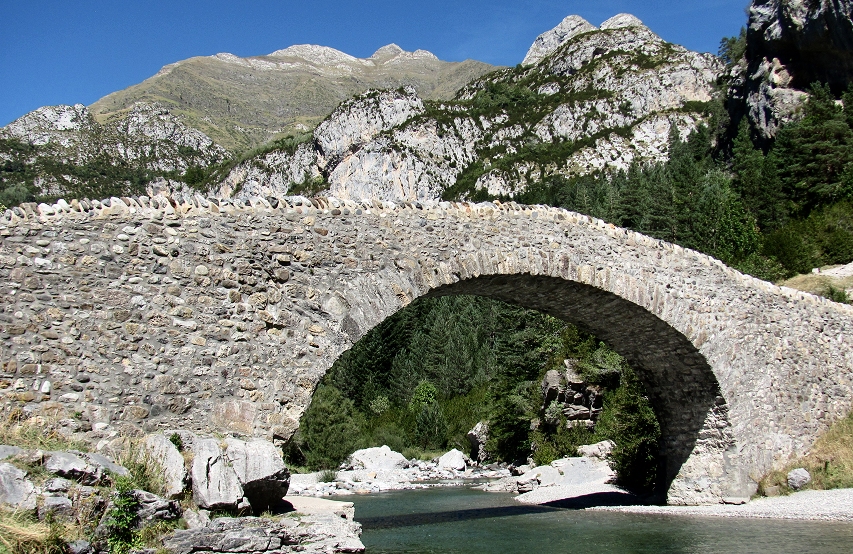
The bridge at San Nicolas de Bujaruelo
Day 7
Overnight in Torla
Breakfast, lunch and dinner included
Travel to the Spanish stone village of Torla at the mouth of Ordesa Canyon. You can choose to hike to Torla via the pass called the Port de Boucharo on one of the old pilgrimage routes to Santiago de Compostela. From the Port de Boucharo, the trail descends into Spain’s Ara River Valley. Near the valley floor are some wonderfully old specimens of the red-berried European yew (Taxus baccata)—called tejo in Spanish. The path eventually arrives at the picturesque stone bridge that spans the Ara River at San Nicolás de Bujaruelo. The path continues downstream through beautiful stands of white fir (Abies alba)—known as abeto in Spanish—to the mouth of the Bujaruelo Valley and Torla. Alternatively, you can travel to Torla by vehicle via the mountain pass known as the Col de Pourtalet. Torla is your base for three nights.
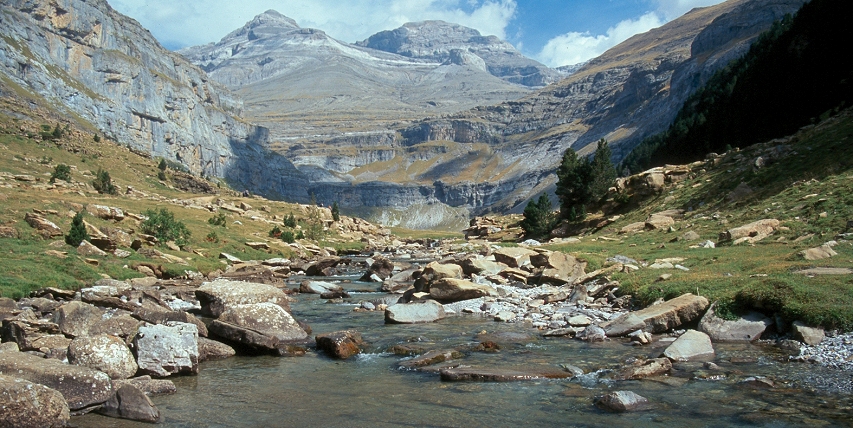
Circo de Soaso, Ordesa Canyon
Day 8
Overnight in Torla
Breakfast, lunch and dinner included
A brief shuttle ride transports you into the Ordesa Canyon with walls soaring 3,000 feet above the canyon floor. The main canyon trail along the Arazas River passes through beautiful beech forests and leads past a series of waterfalls including the lovely Cascada de la Cueva (“waterfall of the cave”) and the stair-stepped cascades of the Gradas de Soaso. For a more challenging option hike along the Faja de Pelay—a natural limestone ledge that contours the south canyon wall about 2,000 feet above the floor of the canyon. The walk along the Faja de Pelay is one of the classic hikes in the Spanish Pyrenees—spectacular and dramatic and well within the reach of an experienced mountain walker. To reach the Faja de Pelay, ascend the switchbacks of the Senda de los Cazadores (“Hunter’s Path”) to the Refugio y Mirador de Calcilarruego. From here, proceed along the Faja de Pelay enjoying magnificent views which include the conspicuous notch of the Brèche de Roland (Brecha de Roldán, in Spanish) and the imposing walls of the Muralla de la Fraucata. The Faja de Pelay trail eventually intersects the floor of the Circo de Soaso at the head of Ordesa Canyon. From here, follow the main Ordesa Canyon trail to return to the trailhead. Enjoy a second evening in Torla.
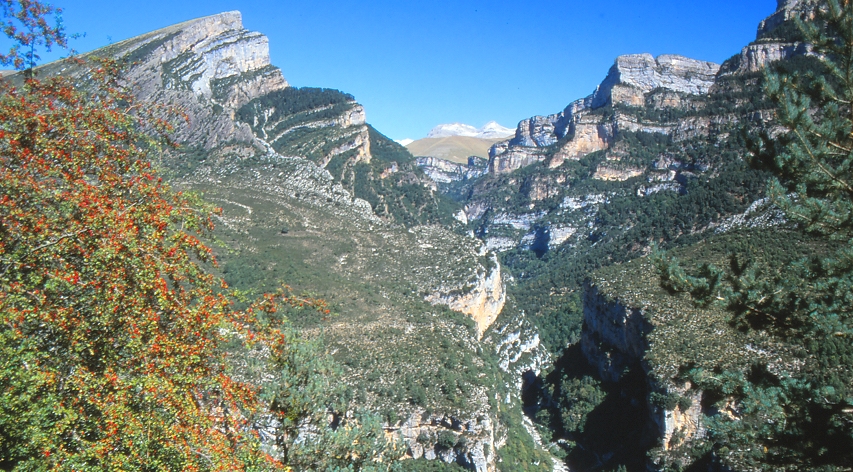
Añisclo Canyon
Day 9
Overnight in Torla
Breakfast, lunch and dinner included
Explore the narrow defile of the Añisclo Canyon where waterfalls plunge over limestone cliffs, and beech and oak forests offer welcome shade to hikers. The canyon’s slender profile makes a hike through Añisclo a more intimate experience than one through its grander neighbor, Ordesa. Most of the route up-canyon is etched into Añisclo’s western wall. Throughout the hike, the dramatic orange and grey walls of the canyon rise sharply above you, and the roar of the Añisclo River is a constant companion. Depending on your pace, you can reach a place called Selva Plana, a shaded plateau deep in canyon country overlooking a particularly narrow portion of the gorge.
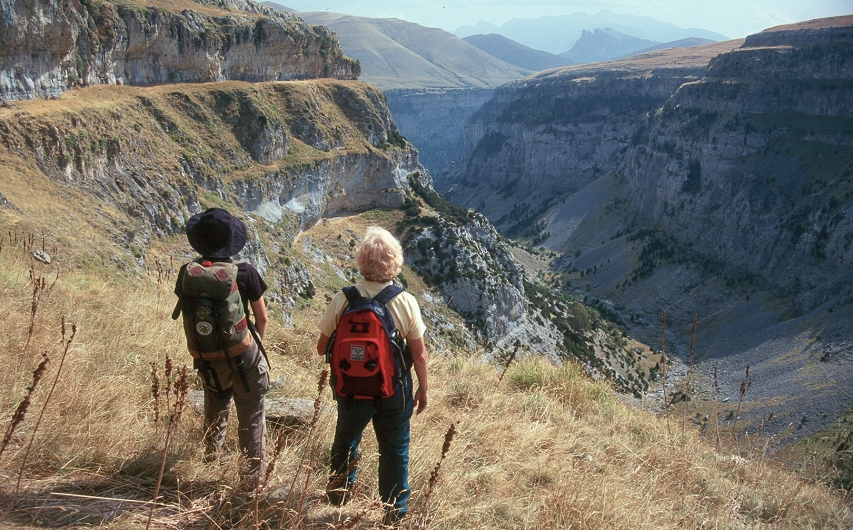
Pardina Canyon, Ordesa-Monte Perdido National Park
Day 10
Overnight in Pau
Breakfast, lunch and dinner included
Travel back to Pau, France via the Tunel de Bielsa. En route, stop for a hike at the remote mountain-top village of Tella. Pine, rosemary, lavender, and boxwood (Buxus sempervirens)—known as boj in Spanish and buis in French—line the fragrant path as it loops by four stone chapels dating from the 11th to the 16th centuries. Take time to enjoy the peace of the surrounding mountains before continuing the journey to Pau. Lodging and a farewell dinner in Pau is included tonight as is your breakfast tomorrow.
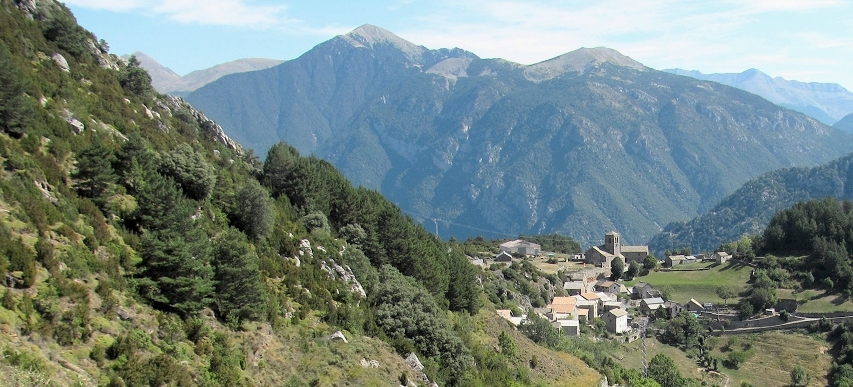
The mountain village of Tella
French & Spanish Pyrenees Slide Show
Photos on this page are by John Osaki (© All Rights Reserved) except as otherwise credited.
Mountain Hiking Holidays
Trips for the adventurous hiker since 1996
PO Box 86250, Portland, OR 97286-0250, USA
info@mountainhikingholidays.com



© Mountain Hiking Holidays, Inc. All rights reserved.
 E-Newsletter Sign-up